You talk to God way more than you listen to Him. Admit it. You hand Him your to-do list with your first cup of coffee, toss up a couple of desperate requests at red lights, and mumble a quick thanks before dinner while somebody’s already grabbing the rolls. Then you wonder why heaven feels so quiet lately.
Here’s the uncomfortable part. Heaven probably isn’t silent. You just haven’t stopped talking long enough to catch what it’s been saying.
What Is Prayerful Meditation and How Does It Work?
Prayerful meditation means paying slow attention to God through His Word. Pick a few verses. Sit with them past the point where you’d normally move on, and somewhere in there they start becoming prayer. There’s no chanting involved. Nobody’s asking you to empty your mind or buy a cushion.
That last bit throws people off. Most popular meditation tells you to clear your head and think about nothing at all. Biblical meditation does the reverse. It fills your head with something worth thinking about.
Psalm 1:2 says the blessed person “meditates on his law day and night.” In Hebrew that word sounds a lot like murmuring. Think about the last time a song got stuck in your head and you caught yourself humming it in the cereal aisle. It’s that, only with Scripture.
The reason faith based meditation works is pretty simple: whatever you feed your mind, it keeps chewing on. Paul knew this. He told the church in Philippi to think about whatever is true, noble, right and pure (Philippians 4:8). Left alone, your mind picks its own menu. Maybe it’s that email from your boss, or the argument you replayed in the shower. Meditation just lets you choose what’s on the plate.
How to Practice Prayerful Meditation: A Step-by-Step Guide
No mountain cabin required, and you can keep your money for the fancy candle. Ten minutes will do. A door that shuts helps.
- Start small, with three or four verses at most, since a whole chapter quietly drags you back into normal reading mode (Psalm 23 works well, and so does Matthew 11:28-30).
- Before you begin, set a ten-minute timer on your phone and turn it face down, which keeps you from checking the clock every ninety seconds.
- Out loud, read the passage twice and take it slow, then pay attention to whatever word jumps out at you on the second read.
- Hang onto that word or phrase for a while, asking first what it says about God and then what He might want from you before lunch.
- When something clicks, tell God about it in plain words, and don’t worry if your prayer comes out awkward or only lasts a sentence.
- For the last minute, say nothing, which is exactly what young Samuel had to learn when he finally answered, “Speak, for your servant is listening” (1 Samuel 3:10).
Your mind will wander off. Honestly, count on it. One minute you’re in Psalm 23, and the next you’re thinking about the dishwasher or that comment your sister made at Easter. Fine. Go back to the phrase. Every time you drag your attention back counts as part of it.
Simple Prayerful Meditation Techniques for Beginners
Give it a week or two and the basic rhythm will feel normal. That’s usually when a few old christian meditation techniques help keep it from going stale.
Lectio divina goes back centuries, to monks who prayed with Scripture in four steps: read it, think about it, answer God, then rest. Sound familiar? It should. The steps above are basically the same thing without the Latin label.
Breath prayer you can take anywhere, even the checkout line. All it asks is that you line up a short phrase from Scripture with your breathing. Breathe in on “Be still.” Breathe out on “and know that I am God” (Psalm 46:10). It works in a traffic jam, in the dentist’s chair, or in a hospital hallway at 2 a.m., which is honestly when most people need it.
The examen is for the end of the day. Lie in bed and ask yourself two questions. Where did I notice God today? Where did I brush Him off? Then pray about both answers. Five honest minutes there will tell you more than a whole week of good intentions.
Plenty of beginners use guided audio at first, and that’s completely fine. Search for christian meditation online and you’ll get hundreds of results, some lovely and some pretty flimsy. A lot of apps for christian meditation are really relaxation apps with a Bible verse glued on top. The best christian meditation apps tend to look almost boring, because they keep Scripture front and center instead of ocean waves. A solid christian mindfulness meditation app leaves you thinking about God. Feeling calmer is a nice bonus, not the goal.
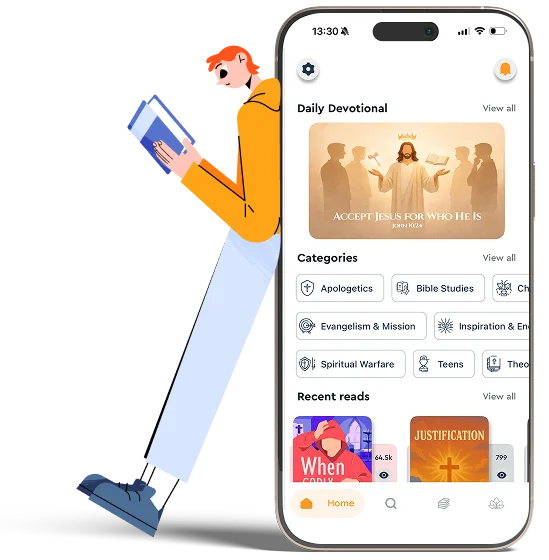
Somewhere around week three, most beginners run into a different wall. You want your meditation to go deeper than a single verse, but you never actually finish the books that would get you there. Maybe you’ve scrolled through a christian bookstore online, piled twenty titles into your cart, and finished two of them. Nobody can download spiritual literacy overnight. You can build it bit by bit, though. Holy Reads pairs guided Christian meditations with christian book summaries you can read or listen to in a few minutes, so your ten minutes can include a passage of Scripture and an insight from someone who spent decades wrestling with it.
How to Make Prayerful Meditation Part of Your Family’s Daily Routine
Kids copy what you do, not what you say. If prayerful meditation only happens behind your bedroom door at 6 a.m., they’ll quietly decide faith is something grown-ups keep to themselves.
Start at dinner. Read one verse out loud before anyone picks up a fork, then go around the table and have everybody name one word that stuck. Your six-year-old will almost certainly say “shepherd.” Your fourteen-year-old will sigh, stare at the ceiling and say “still.” Both answers count.
Bedtime is great with little ones. Teach them a breath prayer from Psalm 4:8. In on “In peace I will lie down and sleep,” and out on “for you alone, LORD, make me dwell in safety.” A kid who’s afraid of the dark now has something real to hold onto when the hall light goes off.
Don’t forget the car. Swap the radio for a two-minute guided meditation on the way to school a couple of mornings a week. Nobody has to say anything deep. They just have to hear it.
Deuteronomy 6:7 tells parents to talk about God’s commands “when you sit at home and when you walk along the road, when you lie down and when you get up.” There’s no binder or sticker chart in that verse. It’s regular Tuesday stuff, filled with God’s Word one small moment at a time.
Pick your verse tonight and read it twice. Then stop talking for one whole minute and pay attention to what comes back.
——————————————————————————————————————————